The Landed Gentry & Us
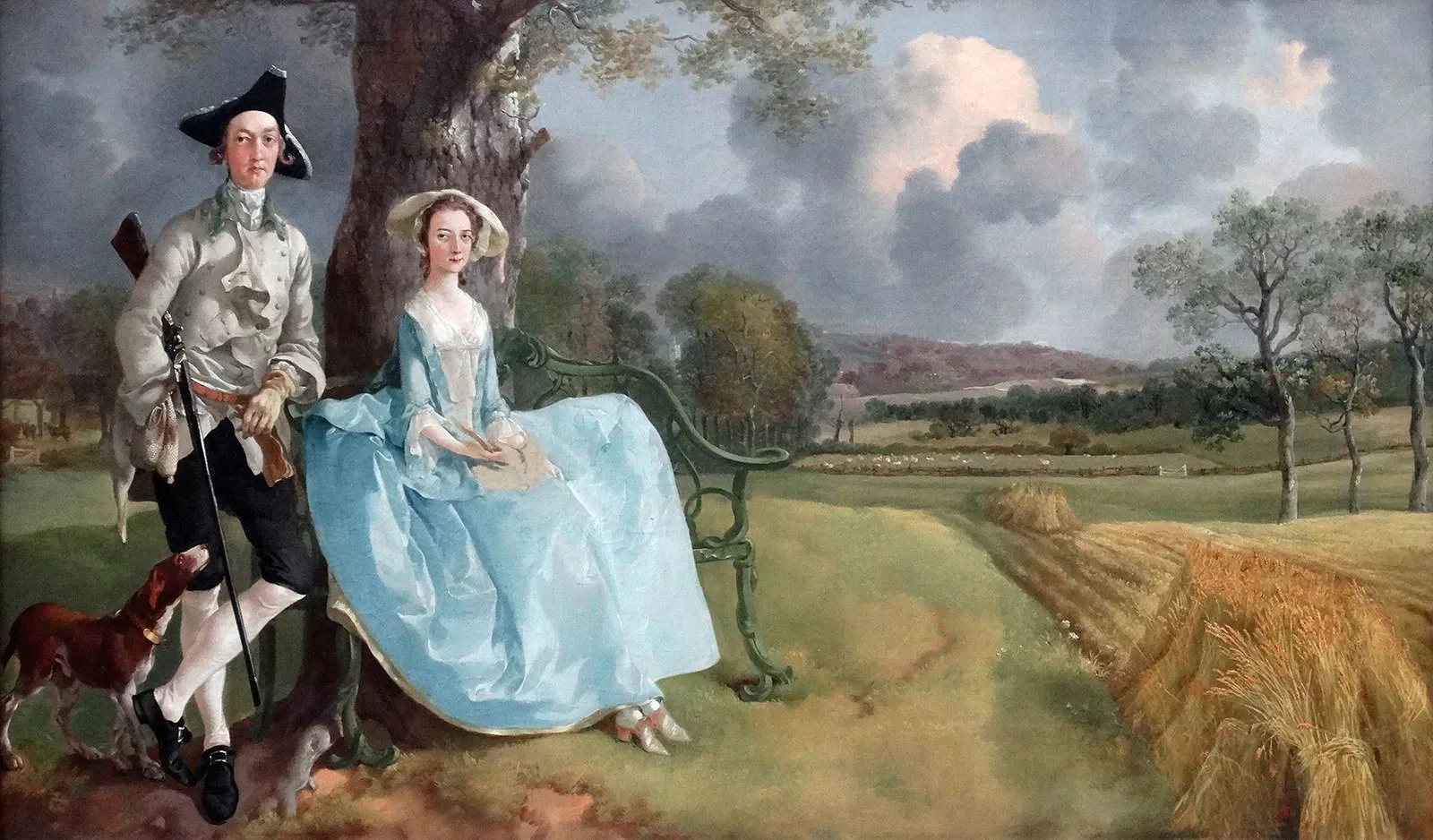
Sometimes it can be fascinating to hear different interpretations of a painting from different art critics. The painting concerned is Mr and Mrs Andrews, dating from around 1750 by Thomas Gainsborough, and the critics are Waldemar Januszczak and Andrew Graham-Dixon.
Graham-Dixon described this painting as representing the very essence of Gainsborough, but he acknowledges that there is a Marxist interpretation of this painting and makes it exhibit A in the case against Gainsborough - that he was essentially a light weight artist and a hireling of the rich who was glamourising an oppressive elite. But was he? He also argues that there is a louche interpretation of the work. The harvested corn in the distance suggests that Mr Andrews has ploughed his wife (who was 18 at the time) and she will soon crop.
So what of Gainsborough himself? He was born in 1727 in Sudbury, Suffolk which was “a cloth town in serious decline” according to Januszczak. He was the youngest of 9 children and his father was a trader in fine silk which the young Thomas was perhaps advertising in some of his early portraits of society women. Januszczak claims Gainsborough was notoriously unimpressed by many of his sitters and would make disparaging remarks about them behind their backs. But Graham-Dixon tells us that he got so aroused by some of them that he would dash off into town afterwards to buy himself a prostitute. Once, he got the clap so badly that rumours of his demise began to circulate and he had to publish a letter in the local newspapers stating that the artist Thomas Gainsborough was still alive.
Gainsborough’s problem was that he was so good at portraiture and he also had the fastest hands in all English art. It’s on the record that he could produce a finished head and shoulders portrait in 100 minutes. Women kept flocking to him to be portrayed as goddesses and, of course, he was more than happy to accept their money. Which is just as well as his father went bankrupt - so young Thomas was never going to enter the cloth business.
There was something of the rebel in Gainsborough. Apparently, he was an expert forger from a young age and would forge sick notes in what appeared to be his parent’s handwriting to get out of school . Keep this in mind.
The Andrews were the “landed gentry”. Mr Andrews inherited half of the estate (Auberies, it was called) depicted in the painting from his father, whilst his wife brought in the other half. So it was a very convenient marriage that made both of them twice as rich.
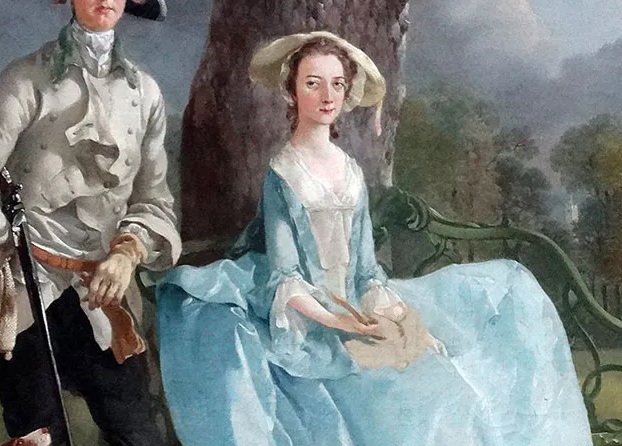
So now we come to that extraordinary portrait of the Andrews. Januszczak wants us to focus on two strange aspects of this painting - the look on Mrs Andrew’s face and the fact that it is unfinished. There is a brown splodge on Mrs Andrews’ lap which suggests there’s something missing. Januszczak found the exact oak tree seen in the painting and we discover that some distance behind the viewer is the family house. The suggestion is that Mr Andrews has been out shooting pheasants and has bought one back for his wife to pluck. If you zoom in closely, you will see she is holding a feather. So what has happened to the bird?
Januszczak may be drawing a long bow here, but he claims Gainsborough was an admirer of Dutch painting. In Dutch art of the time, women were often depicted clutching a dead bird and the bird was thought to represent a man who had fallen into the clutches of a determined woman and been plucked. Just such a painting is presented below, and check out the woman on the far left. This imagery is thought to represent a warning to men.
So Gainborough’s painting may have been a warning to Mr Andrews of the fate of men who have been grabbed and plucked. Januszczak believes that the sitters finally realized what Gainsborough intentions were and didn’t like it, so they ordered him to paint the bird out.
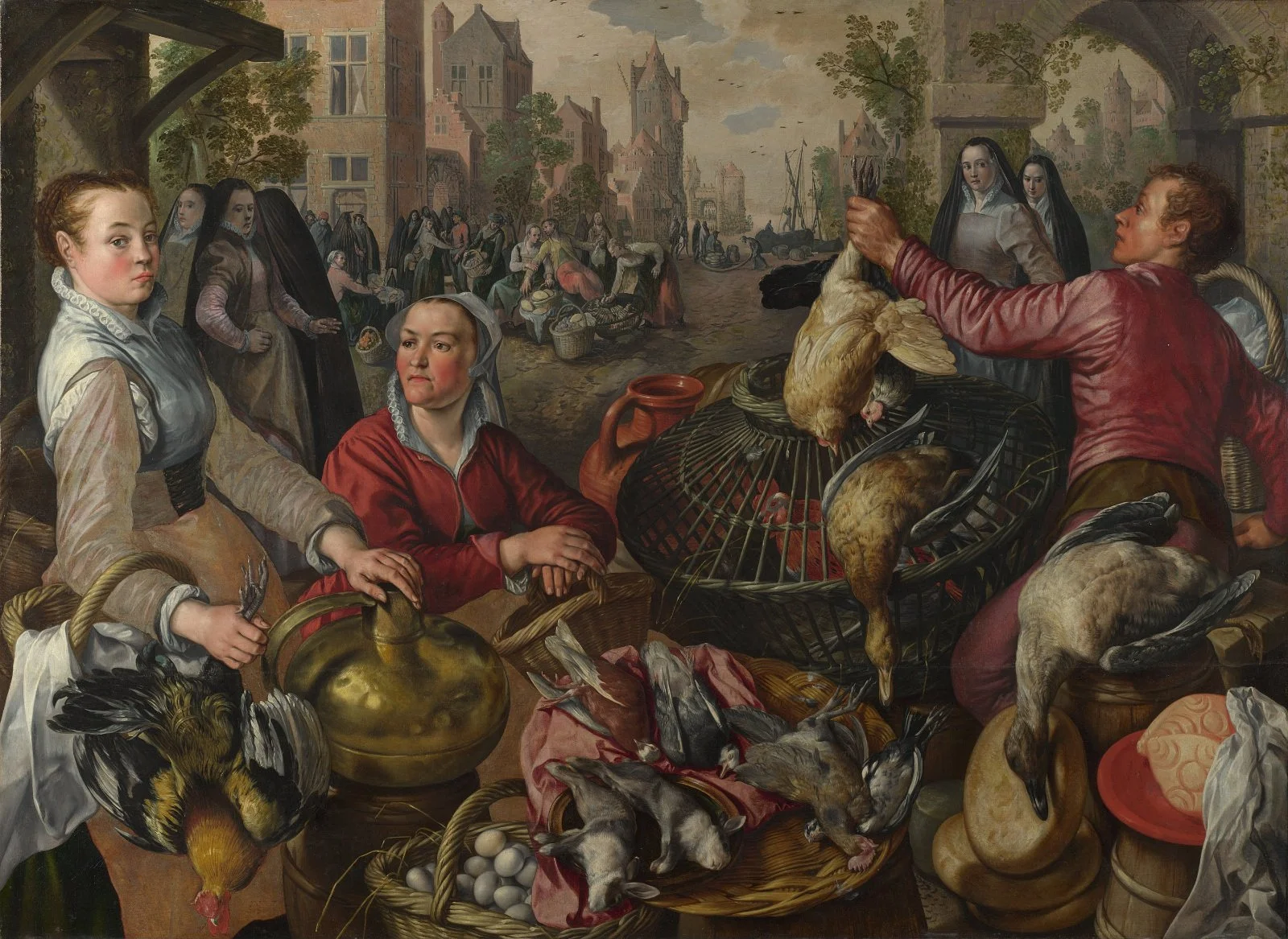
Joachim Beuckelaer, The Four Elements of Air, 1570
There is one other piece of information that may be relevant - the Enclosure Acts of the 18th Century, thought to be one of the most destructive pieces of legislation ever passed by the British Parliament. It took the common land away from the people and gave it to the landlords who then fenced it off. It was effectively the privatization of land and it threw many farm workers into poverty. Gainsborough was appalled by this legislation and some of his art suggests his sympathies lay with the poor, not the wealthy.
So the painting may represent, in Januszczak’ words, the depiction of two small town moneybags who had struck it rich. Perhaps this painting may not represent a celebration of the landed gentry that many of us may have assumed.
References;
Waldemar Januszczak - The Art Mysteries - Perspective
Andrew Graham-Dixon - A History of British Art - BBC